
January 26, 1788 marks the arrival of the First Fleet of British ships at Port Jackson in New South Wales, Australia. This anniversary has been acknowledged as Australia Day by all Australian states and territories since 1935 and celebrated as the official National Day of Australia, with a public holiday, since 1994. However, whilst the intention behind Australia Day is to ‘come together as a nation to celebrate what’s great about Australia and being Australian’, usually with a few drinks and a BBQ, the day the First Fleet arrived in Australia is not one of celebration for all Indigenous Australians. For some of the Indigenous community, January 26 is known as Invasion Day or a Day of Mourning, a day which marks the beginning of European colonisation in Australia and the ongoing suffering of Indigenous Australians. In recent years calls to change the date of Australia Day have grown for this reason, culminating in 2017 with some of the biggest ‘Change the Date’ protests the country has seen.
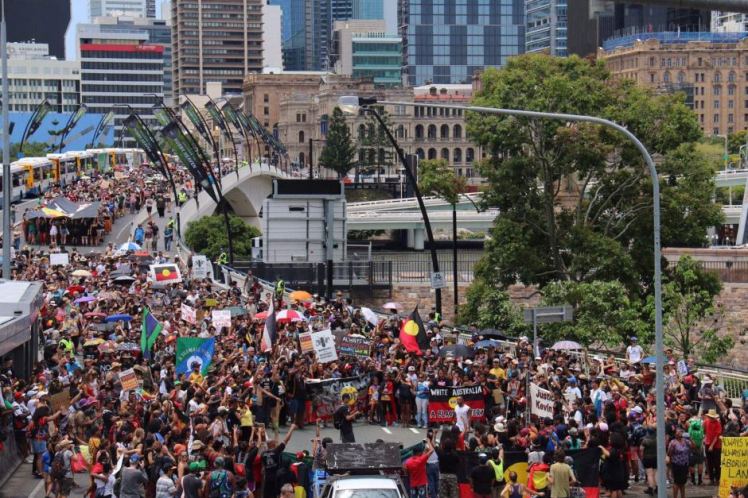 ‘Change the date’ protests in Melbourne, January 2017 (Source: http://www.abc.net.au)
There are arguments for and against changing the date from the perspectives of both Indigenous and non-Indigenous Australians. Some non-Indigenous Australians argue ‘We weren’t alive in 1788, it is time to move on’ while others state ‘it is time focus on more important issues facing the Indigenous community’ and to look forwards rather than backwards. I think others are just blasé about the whole thing. What I personally was reminded of, yet again, is how much I do not know, or remember learning, about Australian history. I consider myself well educated; I have two bachelor degrees, with majors in history subjects, honours in Asian Studies and further post-graduate study in museums and cultural heritage. As a child I loved history, museums and understanding ancient cultures. However, as an adult I am realising that my knowledge of Aboriginal culture has waned since my primary school years in Hobart, Tasmania. I believe that most non-Indigenous Australians remain ignorant of many of the issues that faced and continue to face Indigenous Australians and most could not answer basic questions about the history and ancient culture of the nation they call home.
In May 2016 I attended the Museums Australasia conference in Auckland, New Zealand (see post) where I was shocked at how much Maori culture is understood, respected and promoted in New Zealand compared to Aboriginal culture in Australia. It was quite embarrassing. It made me think, ‘what does your average non-Indigenous Australian even knew about Aboriginal culture?’ If I was struggling to explain Indigenous Australian history to museum colleagues in New Zealand with my background, surely there is a problem? Was it just that I had forgotten all I was taught in school, was it that I had grown up in a very ‘white’ Tasmania, or was it that I hadn’t been exposed to Aboriginal culture regularly or at all?
It was probably all of the above and then some. I remember learning about the Aboriginal Dreamtime and trying to make Aboriginal-style paintings in primary school. I remember my family trip to Yulara, in the Northern Territory when I was 5 years old and visiting Ayers Rock, as Uluru was then known. I brought home a glow in the dark witchetty grub magnet, Aboriginal clapstick souvenirs and other such objects that are most likely not culturally sensitive.
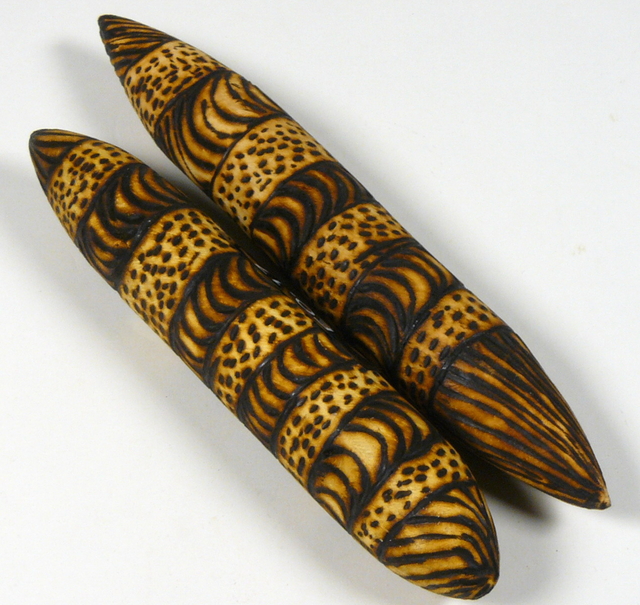 Clapsticks at the National Museum of Australia (Source: NMA)
An enduring memory from the Tasmanian Museum and Art Gallery (TMAG) is the diorama exhibit of an Aboriginal family sitting in front of a fire and their huts. It is no longer there, but the image is forever burned in my mind, as is the megafauna exhibit, the Tasmanian Tiger specimen jars, the convict uniforms and of course my favourite, the Egyptian mummy under the stairs (which I have since found has sadly moved in the latest renovations). However, I do not remember an exhibition devoted to Indigenous Australian history at TMAG during my childhood. In fact, my only childhood memories of learning about Indigenous Australian history and the impact of colonialism were in high school when our class studied the text Their Ghosts May Be Heard: Australia to 1900 and watched the film Walkabout (1971).
In late 2016 I attended the ‘Illuminating Australian Art’ series organised by the National Gallery of Victoria. Session 1, which focussed on Colonial art from (1790-1880), featured talks by Prof. Sasha Grishin and Prof. Brian Martin on the role of Indigenous art in the development of art on the Australian continent and the flawed representation of Indigenous Australians by colonial artists. I left this session with a whole new perspective on some of my favourite colonial art works, but more importantly, I was again astonished about facts which I did not know, or had forgotten I had known about Indigenous Australians. For example, Martin reminded attendees that prior to the 1967 referendum, Indigenous people were regulated under the Flora and Fauna Act. Martin also introduced a new shocking fact to me; Aboriginal Australians were instructed to ‘hand in’ their cultural heritage in order to be considered for opportunities available to white Australians. By signing official documents, which prohibited any expressions of Aboriginality, including language, dance and spirituality they were allowed to better their position in life.
 Walter Davis’ Certificate of Exemption, issued by the Aboriginal Welfare Board in 1957 (Source: http://www.abc.net.au/2014-02-05/dog-licence/5240070)
So why don’t I know this? Is Indigenous Australian history not taught, promoted and celebrated enough? Or have I just not been paying attention?
Shortly after Australia Day this year I read the following Facebook post from retired Indigenous athlete and ex politician Nova Peris AOM:
“I will continue to speak out until there is one day a dedicated historical museum built in this country displaying the full warts n all history of Aboriginal & Torres Strait Australia. This museum should be on par with the holocaust one in Germany or the apartheid one in South Africa. Acknowledge the history, understand the history, teach the history and we can all heal and come together. Australia is an amazing, young country and the 40,000 + years of Aboriginal culture should compliment the nation, be respected, valued and spoken of with pride when comparing to other nations around the world.”
Whilst there are plenty of museum wings, exhibits, sections of galleries and collections devoted to Indigenous art, history and culture, Australia does not have a dedicated national museum for Indigenous Australian history. Peris’ post prompted me to question, could a national museum for Indigenous Australian History help educate the next generation of Australians and help them understand the early history of their country? The precedent has been set by the National Museum of African American History and Culture in the USA, whose mission is to ‘reframe American history through an African-American lens. The museum is, according to founding director Lonnie Bush, ‘a clarion call to remember.’ Surely it is about time Australia remembered too.
 little ostraca